 Add to Chrome
 Add to Firefox
 Add to Edge
Cross-Modal Clinical Knowledge Integration for Mammography Report Generation
May 29, 2026
Breast cancer is a major global health concern, and mammography screening plays a central role in early detection. The large volume of screening examinations creates a substantial workload for radiologists, making accurate and consistent report generation a critical clinical challenge. Existing automated mammography report generation methods primarily focus on direct visual-to-text mapping, while overlooking the structured clinical reasoning process followed by radiologists in real-world practice. To address this limitation, we propose MammoRG, a mammography report generation framework that explicitly simulates the clinical reporting workflow by following the BI-RADS guideline and incorporating prior clinical knowledge to produce diagnostic reports. Specifically, MammoRG adopts a two-stage training framework. In the first stage, the model learns to integrate clinically relevant prior knowledge from a patient's four-view mammograms through classification-based supervision. In the second stage, a terminology-aware supervised fine-tuning strategy is introduced to model mammography-specific clinical terms as atomic semantic units, enabling the generation of high-quality reports with improved clinical consistency. To facilitate clinical efficacy evaluation of generated reports, we further develop MammoRGTool, a dedicated mammography report parsing tool that extracts structured clinical information from free-text reports. Extensive experiments demonstrate that MammoRG consistently outperforms existing methods across multiple clinical efficacy metrics, particularly in diagnosis-related BI-RADS F1, where it surpasses the second-best model by 2.73%, 2.04%, 1.90%, and 3.27% on the internal, external 1, external 2, and VinDr-Mammo datasets, respectively.

Multimodal Reasoning with LLM for Encrypted Traffic Interpretation: A Benchmark
Apr 09, 2026Network traffic, as a key media format, is crucial for ensuring security and communications in modern internet infrastructure. While existing methods offer excellent performance, they face two key bottlenecks: (1) They fail to capture multidimensional semantics beyond unimodal sequence patterns. (2) Their black box property, i.e., providing only category labels, lacks an auditable reasoning process. We identify a key factor that existing network traffic datasets are primarily designed for classification and inherently lack rich semantic annotations, failing to generate human-readable evidence report. To address data scarcity, this paper proposes a Byte-Grounded Traffic Description (BGTD) benchmark for the first time, combining raw bytes with structured expert annotations. BGTD provides necessary behavioral features and verifiable chains of evidence for multimodal reasoning towards explainable encrypted traffic interpretation. Built upon BGTD, this paper proposes an end-to-end traffic-language representation framework (mmTraffic), a multimodal reasoning architecture bridging physical traffic encoding and semantic interpretation. In order to alleviate modality interference and generative hallucinations, mmTraffic adopts a jointly-optimized perception-cognition architecture. By incorporating a perception-centered traffic encoder and a cognition-centered LLM generator, mmTraffic achieves refined traffic interpretation with guaranteed category prediction. Extensive experiments demonstrate that mmTraffic autonomously generates high-fidelity, human-readable, and evidence-grounded traffic interpretation reports, while maintaining highly competitive classification accuracy comparing to specialized unimodal model (e.g., NetMamba). The source code is available at https://github.com/lgzhangzlg/Multimodal-Reasoning-with-LLM-for-Encrypted-Traffic-Interpretation-A-Benchmark
Mean Masked Autoencoder with Flow-Mixing for Encrypted Traffic Classification
Mar 31, 2026Network traffic classification using self-supervised pre-training models based on Masked Autoencoders (MAE) has demonstrated a huge potential. However, existing methods are confined to isolated byte-level reconstruction of individual flows, lacking adequate perception of the multi-granularity contextual relationship in traffic. To address this limitation, we propose Mean MAE (MMAE), a teacher-student MAE paradigm with flow mixing strategy for building encrypted traffic pre-training model. MMAE employs a self-distillation mechanism for teacher-student interaction, where the teacher provides unmasked flow-level semantic supervision to advance the student from local byte reconstruction to multi-granularity comprehension. To break the information bottleneck in individual flows, we introduce a dynamic Flow Mixing (FlowMix) strategy to replace traditional random masking mechanism. By constructing challenging cross-flow mixed samples with interferences, it compels the model to learn discriminative representations from distorted tokens. Furthermore, we design a Packet-importance aware Mask Predictor (PMP) equipped with an attention bias mechanism that leverages packet-level side-channel statistics to dynamically mask tokens with high semantic density. Numerous experiments on a number of datasets covering encrypted applications, malware, and attack traffic demonstrate that MMAE achieves state-of-the-art performance. The code is available at https://github.com/lx6c78/MMAE
Free Lunch in Medical Image Foundation Model Pre-training via Randomized Synthesis and Disentanglement
Feb 12, 2026Medical image foundation models (MIFMs) have demonstrated remarkable potential for a wide range of clinical tasks, yet their development is constrained by the scarcity, heterogeneity, and high cost of large-scale annotated datasets. Here, we propose RaSD (Randomized Synthesis and Disentanglement), a scalable framework for pre-training MIFMs entirely on synthetic data. By modeling anatomical structures and appearance variations with randomized Gaussian distributions, RaSD exposes models to sufficient multi-scale structural and appearance perturbations, forcing them to rely on invariant and task-relevant anatomical cues rather than dataset-specific textures, thereby enabling robust and transferable representation learning. We pre-trained RaSD on 1.2 million 3D volumes and 9.6 million 2D images, and extensively evaluated the resulting models across 6 imaging modalities, 48 datasets, and 56 downstream tasks. Across all evaluated downstream tasks, RaSD consistently outperforms training-from-scratch models, achieves the best performance on 17 tasks, and remains comparable to models pre-trained on large real datasets in most others. These results demonstrate that the capacity of synthetic data alone to drive robust representation learning. Our findings establish a paradigm shift in medical AI, demonstrating that synthetic data can serve as a "free lunch" for scalable, privacy-preserving, and clinically generalizable foundation models.
Implicit Non-Causal Factors are Out via Dataset Splitting for Domain Generalization Object Detection
Jan 27, 2026Open world object detection faces a significant challenge in domain-invariant representation, i.e., implicit non-causal factors. Most domain generalization (DG) methods based on domain adversarial learning (DAL) pay much attention to learn domain-invariant information, but often overlook the potential non-causal factors. We unveil two critical causes: 1) The domain discriminator-based DAL method is subject to the extremely sparse domain label, i.e., assigning only one domain label to each dataset, thus can only associate explicit non-causal factor, which is incredibly limited. 2) The non-causal factors, induced by unidentified data bias, are excessively implicit and cannot be solely discerned by conventional DAL paradigm. Based on these key findings, inspired by the Granular-Ball perspective, we propose an improved DAL method, i.e., GB-DAL. The proposed GB-DAL utilizes Prototype-based Granular Ball Splitting (PGBS) module to generate more dense domains from limited datasets, akin to more fine-grained granular balls, indicating more potential non-causal factors. Inspired by adversarial perturbations akin to non-causal factors, we propose a Simulated Non-causal Factors (SNF) module as a means of data augmentation to reduce the implicitness of non-causal factors, and facilitate the training of GB-DAL. Comparative experiments on numerous benchmarks demonstrate that our method achieves better generalization performance in novel circumstances.
Proxy Robustness in Vision Language Models is Effortlessly Transferable
Jan 19, 2026As a pivotal technique for improving the defense of deep models, adversarial robustness transfer via distillation has demonstrated remarkable success in conventional image classification tasks. However, this paradigm encounters critical challenges when applied to vision-language models (VLM) (e.g., CLIP): constructing adversarially robust teacher for large-scale multi-modal models demands prohibitively high computational resources. We bridge this gap by revealing an interesting phenomenon: vanilla CLIP (without adversarial training) exhibits intrinsic defensive capabilities against adversarial examples generated by another CLIP with different architectures. We formally define this as proxy adversarial robustness, and naturally propose a Heterogeneous Proxy Transfer (HPT) framework that establishes cross-architectural robustness distillation channels between CLIP variants, effortlessly enabling the VLM robustness transfer from proxy to target models. Yet, such proxy transfer paradigm easily induces severe overfitting, leading to a sharp degradation in zero-shot natural generalization. To resolve that, we design Generalization-Pivot Decoupling (GPD) by leveraging the difference in learning rate scheduling. This decouples the proxy transfer process into a generalization-anchored warm-up that maintains generalization and a generalization-pulled HPT that promotes adversarial robustness, to achieve an equilibrium between natural generalization and adversarial robustness. Extensive experiments on 15 zero-shot datasets demonstrate the effectiveness of our HPT-GPD method. The code is available at the website of github.com/fxw13/HPT-GPD.
Unsupervised Robust Domain Adaptation: Paradigm, Theory and Algorithm
Nov 14, 2025Unsupervised domain adaptation (UDA) aims to transfer knowledge from a label-rich source domain to an unlabeled target domain by addressing domain shifts. Most UDA approaches emphasize transfer ability, but often overlook robustness against adversarial attacks. Although vanilla adversarial training (VAT) improves the robustness of deep neural networks, it has little effect on UDA. This paper focuses on answering three key questions: 1) Why does VAT, known for its defensive effectiveness, fail in the UDA paradigm? 2) What is the generalization bound theory under attacks and how does it evolve from classical UDA theory? 3) How can we implement a robustification training procedure without complex modifications? Specifically, we explore and reveal the inherent entanglement challenge in general UDA+VAT paradigm, and propose an unsupervised robust domain adaptation (URDA) paradigm. We further derive the generalization bound theory of the URDA paradigm so that it can resist adversarial noise and domain shift. To the best of our knowledge, this is the first time to establish the URDA paradigm and theory. We further introduce a simple, novel yet effective URDA algorithm called Disentangled Adversarial Robustness Training (DART), a two-step training procedure that ensures both transferability and robustness. DART first pre-trains an arbitrary UDA model, and then applies an instantaneous robustification post-training step via disentangled distillation.Experiments on four benchmark datasets with/without attacks show that DART effectively enhances robustness while maintaining domain adaptability, and validate the URDA paradigm and theory.
A Survey of Multimodal Composite Editing and Retrieval
Sep 11, 2024In the real world, where information is abundant and diverse across different modalities, understanding and utilizing various data types to improve retrieval systems is a key focus of research. Multimodal composite retrieval integrates diverse modalities such as text, image and audio, etc. to provide more accurate, personalized, and contextually relevant results. To facilitate a deeper understanding of this promising direction, this survey explores multimodal composite editing and retrieval in depth, covering image-text composite editing, image-text composite retrieval, and other multimodal composite retrieval. In this survey, we systematically organize the application scenarios, methods, benchmarks, experiments, and future directions. Multimodal learning is a hot topic in large model era, and have also witnessed some surveys in multimodal learning and vision-language models with transformers published in the PAMI journal. To the best of our knowledge, this survey is the first comprehensive review of the literature on multimodal composite retrieval, which is a timely complement of multimodal fusion to existing reviews. To help readers' quickly track this field, we build the project page for this survey, which can be found at https://github.com/fuxianghuang1/Multimodal-Composite-Editing-and-Retrieval.
Gradient Harmonization in Unsupervised Domain Adaptation
Aug 01, 2024Unsupervised domain adaptation (UDA) intends to transfer knowledge from a labeled source domain to an unlabeled target domain. Many current methods focus on learning feature representations that are both discriminative for classification and invariant across domains by simultaneously optimizing domain alignment and classification tasks. However, these methods often overlook a crucial challenge: the inherent conflict between these two tasks during gradient-based optimization. In this paper, we delve into this issue and introduce two effective solutions known as Gradient Harmonization, including GH and GH++, to mitigate the conflict between domain alignment and classification tasks. GH operates by altering the gradient angle between different tasks from an obtuse angle to an acute angle, thus resolving the conflict and trade-offing the two tasks in a coordinated manner. Yet, this would cause both tasks to deviate from their original optimization directions. We thus further propose an improved version, GH++, which adjusts the gradient angle between tasks from an obtuse angle to a vertical angle. This not only eliminates the conflict but also minimizes deviation from the original gradient directions. Finally, for optimization convenience and efficiency, we evolve the gradient harmonization strategies into a dynamically weighted loss function using an integral operator on the harmonized gradient. Notably, GH/GH++ are orthogonal to UDA and can be seamlessly integrated into most existing UDA models. Theoretical insights and experimental analyses demonstrate that the proposed approaches not only enhance popular UDA baselines but also improve recent state-of-the-art models.
Foundation Model for Advancing Healthcare: Challenges, Opportunities, and Future Directions
Apr 04, 2024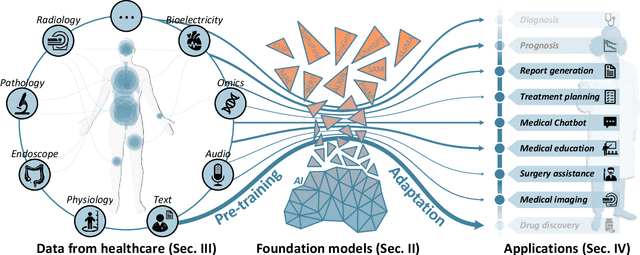
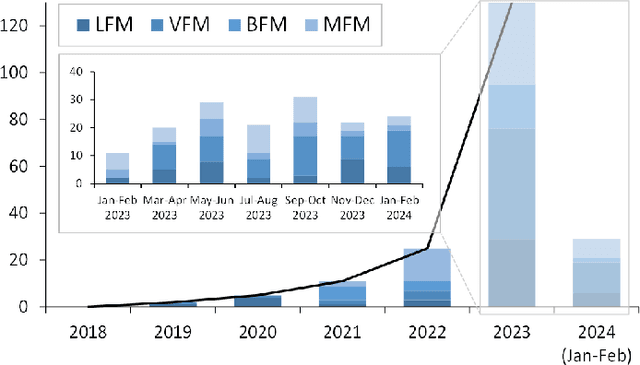
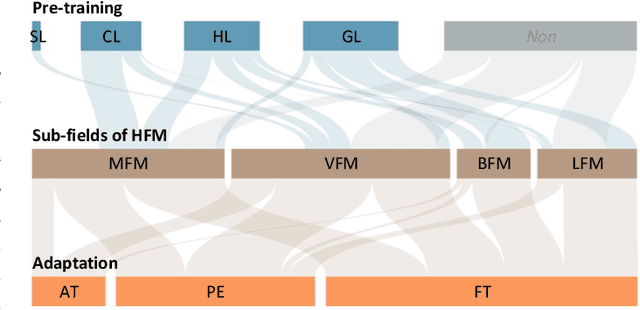
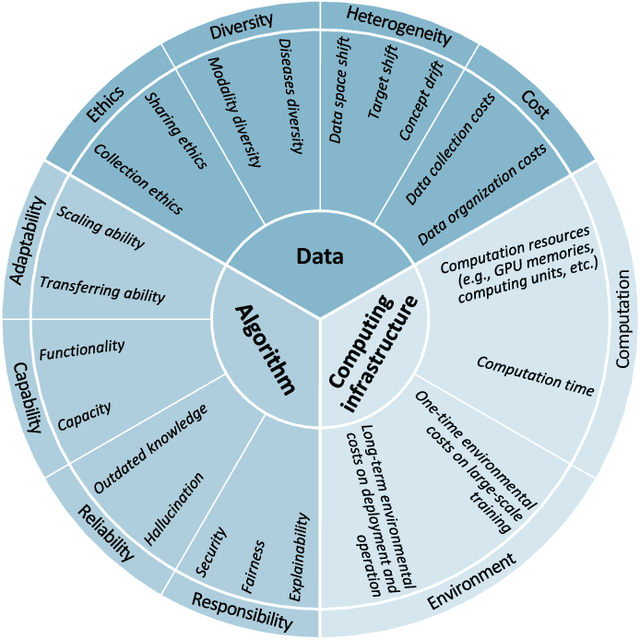
Foundation model, which is pre-trained on broad data and is able to adapt to a wide range of tasks, is advancing healthcare. It promotes the development of healthcare artificial intelligence (AI) models, breaking the contradiction between limited AI models and diverse healthcare practices. Much more widespread healthcare scenarios will benefit from the development of a healthcare foundation model (HFM), improving their advanced intelligent healthcare services. Despite the impending widespread deployment of HFMs, there is currently a lack of clear understanding about how they work in the healthcare field, their current challenges, and where they are headed in the future. To answer these questions, a comprehensive and deep survey of the challenges, opportunities, and future directions of HFMs is presented in this survey. It first conducted a comprehensive overview of the HFM including the methods, data, and applications for a quick grasp of the current progress. Then, it made an in-depth exploration of the challenges present in data, algorithms, and computing infrastructures for constructing and widespread application of foundation models in healthcare. This survey also identifies emerging and promising directions in this field for future development. We believe that this survey will enhance the community's comprehension of the current progress of HFM and serve as a valuable source of guidance for future development in this field. The latest HFM papers and related resources are maintained on our website: https://github.com/YutingHe-list/Awesome-Foundation-Models-for-Advancing-Healthcare.